
Uganda vs Rwanda Gorilla Trekking: Which Is Better for Your Safari?
Gorilla Trekking
kuzoraadmin
Kuzora Safari Travel Expert
Uganda or Rwanda for Gorilla Trekking?
Choose Uganda gorilla trekking if you want better value, more park and sector choices, a richer safari itinerary, and the option to combine gorillas with chimpanzees, wildlife safaris, Lake Bunyonyi, Queen Elizabeth National Park, Murchison Falls, or even Rwanda.
Choose Rwanda gorilla trekking if you want the quickest and smoothest gorilla trip, premium luxury lodges, shorter driving time, and a high-end experience around Volcanoes National Park.
If cost matters, Uganda wins. If time and luxury convenience matter more, Rwanda wins. If you want the best overall safari experience, Uganda is usually the stronger choice because it gives you more variety for the money
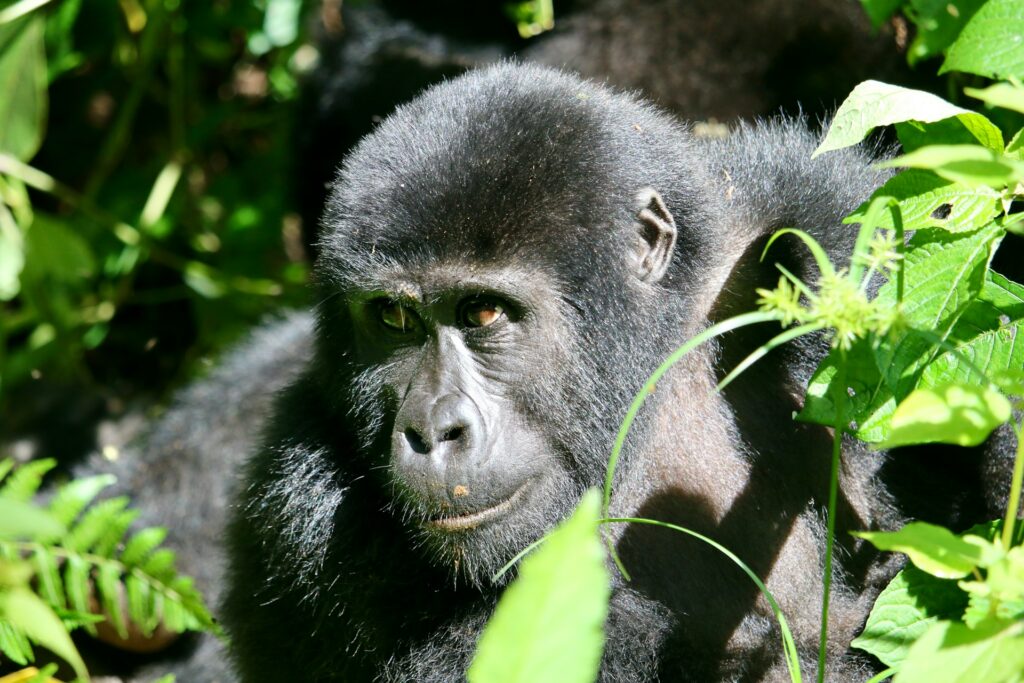
Uganda vs Rwanda gorilla trekking is one of the biggest questions travelers ask when planning a mountain gorilla safari in East Africa. Both countries offer unforgettable gorilla encounters. Both protect endangered mountain gorillas. Both have trained guides, official permits, and beautiful forest scenery. But they do not offer the same experience.
The simple answer is this: Uganda is usually better for value, longer safaris, and travelers who want more than one gorilla trekking option. Rwanda is usually better for luxury, shorter trips, and travelers who want the easiest access from the airport to the gorilla park.
But that answer is too short if you are about to spend serious money on a once-in-a-lifetime safari. The better choice depends on your budget, time, fitness, travel style, lodge preference, and whether you want gorillas only or a fuller East African safari.
This guide compares Uganda vs Rwanda gorilla trekking honestly, from permit cost and park access to trekking difficulty, scenery, accommodation, and overall value. By the end, you should know which country fits your trip better and how Kuzora Safari Tours can help you plan it properly.
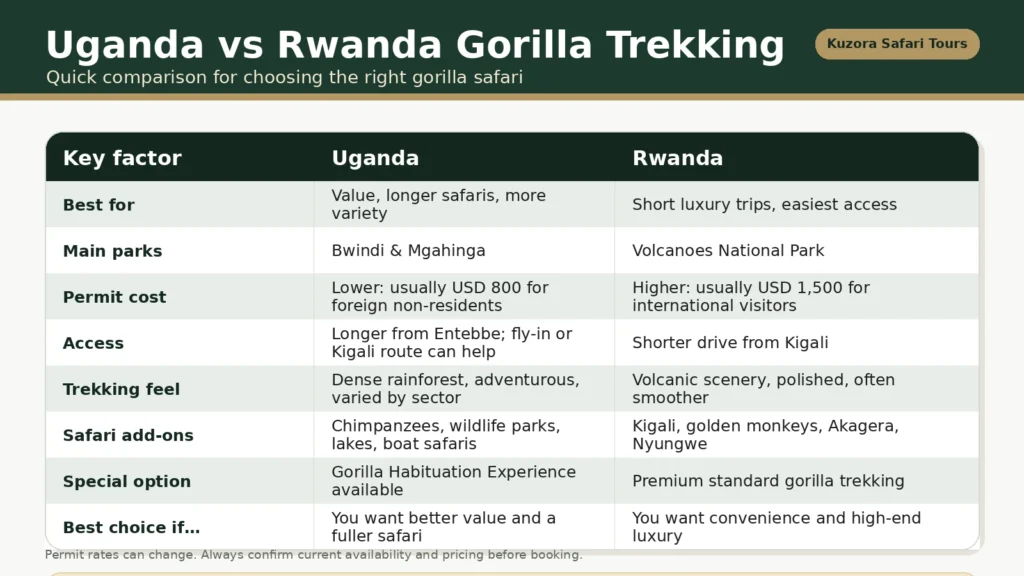
Uganda vs Rwanda Gorilla Trekking Comparison Table
| Factor | Uganda | Rwanda |
|---|---|---|
| Main gorilla parks | Bwindi Impenetrable National Park and Mgahinga Gorilla National Park | Volcanoes National Park |
| Gorilla permit cost | USD 800 for foreign non-residents under the current UWA tariff | USD 1,500 for international visitors |
| Best for | Value, longer safaris, variety, repeat treks | Luxury, short trips, easier access |
| Travel time from main airport | Longer by road from Entebbe; fly-in options available | Shorter drive from Kigali to Volcanoes National Park |
| Trekking style | Forested, adventurous, varied by Bwindi sector | Often more accessible, volcanic scenery |
| Gorilla habituation | Available in Uganda, mainly associated with Bwindi | Not the same standard tourist habituation option |
| Safari combinations | Gorillas, chimpanzees, Big Five-style wildlife, boat safaris, cultural experiences | Gorillas, golden monkeys, Kigali, Akagera, Nyungwe |
| Overall value | Stronger | More expensive |
| Best choice for first-time safari travelers | Uganda if you want a complete safari | Rwanda if you want a short luxury gorilla trip |
Where Do You Trek Gorillas in Uganda?
Uganda has two official mountain gorilla trekking destinations: Bwindi Impenetrable National Park and Mgahinga Gorilla National Park.
Bwindi is the main gorilla trekking destination in Uganda. It is a thick, ancient rainforest in southwestern Uganda and is divided into four main trekking sectors: Buhoma, Ruhija, Rushaga, and Nkuringo. Each sector has different terrain, lodge options, road access, and gorilla families.
Uganda Wildlife Authority describes Bwindi as protecting approximately 459 mountain gorillas, almost half of the world’s remaining mountain gorilla population. Uganda also states that the country has more than half of the world’s mountain gorillas across Bwindi and Mgahinga.
Mgahinga is smaller but very scenic. It sits in the Virunga Mountains and is a strong choice for travelers who want mountain views, golden monkey tracking, and a quieter gorilla trekking atmosphere.
For most Kuzora clients, Bwindi is the better fit because it gives more flexibility. You can choose a sector depending on your route, lodge preference, budget, and whether you are combining gorillas with other Uganda safari destinations.
Where Do You Trek Gorillas in Rwanda?
Rwanda’s gorilla trekking takes place in Volcanoes National Park, in the northwestern part of the country near Musanze.
This is the famous land of volcanic slopes, bamboo forests, and the legacy of Dian Fossey’s gorilla conservation work. Rwanda’s gorilla trekking experience is highly organized, polished, and easy to access from Kigali.
Visit Rwanda states that gorilla tracking permits are limited, with eight permits issued per gorilla troop per day and only 96 permits available each day in Rwanda.
This limited daily access helps protect the gorillas and keeps the experience intimate, but it also means permits should be planned early, especially in peak travel months.
Uganda Gorilla Permit Cost vs Rwanda Gorilla Permit Cost
This is where the difference becomes very clear.
Under Uganda Wildlife Authority’s Conservation Tariff for July 2024 to June 2026, a Uganda gorilla permit costs USD 800 for foreign non-residents, USD 700 for foreign residents, USD 500 for Rest of Africa visitors, and UGX 300,000 for East African citizens. The same tariff lists Uganda’s gorilla habituation experience at USD 1,500 for foreign non-residents. These rates include guide fee, park entrance fees for the day, and community development contribution.
Rwanda’s official booking portal lists the mountain gorilla tracking permit at USD 1,500 for foreign visitors, with lower listed rates for some resident and regional categories. Visit Rwanda also states that gorilla permits cost USD 1,500 per person per day for international visitors.
So for many international travelers, Uganda saves about USD 700 per person per trek compared with Rwanda.
That difference becomes serious for couples, families, photographers, or travelers who want to trek twice. For two international travelers doing one gorilla trek each, Uganda can save around USD 1,400 on permits alone. If each person treks twice, the permit saving can be around USD 2,800.
This is one of the main reasons Uganda wins the value argument in Uganda vs Rwanda gorilla trekking.
Is Uganda Gorilla Trekking Cheaper Than Rwanda?
Yes, for most international travelers, Uganda gorilla trekking is cheaper than Rwanda gorilla trekking because the gorilla permit is significantly lower.
But Gorilla permit cost is not the only cost. You should also consider:
- Accommodation
- Transport
- Fuel
- Guide fees
- Domestic flights, if used
- Number of safari days
- Border crossing, if combining both countries
- Activities before or after gorilla trekking
- Comfort level of lodges
A short Rwanda gorilla safari can sometimes have fewer transport days because Volcanoes National Park is easier to reach from Kigali. But even with that advantage, Rwanda usually remains more expensive because of the USD 1,500 permit and its strong luxury positioning.
Uganda may require longer driving if starting from Entebbe, but it gives more itinerary value. You can turn the journey into a real safari by adding Lake Mburo, Queen Elizabeth National Park, Kibale Forest, Lake Bunyonyi, or Murchison Falls.
So if your question is only, “Which country has the cheaper gorilla permit?” the answer is Uganda. If your question is, “Which country gives better value for a full safari?” the answer is also usually Uganda.
Which Country Is Easier to Reach for Gorilla Trekking?
Rwanda is easier if you want the shortest transfer from the international airport to the gorilla trekking area.
You can land in Kigali and drive to Volcanoes National Park in a few hours, depending on traffic, road conditions, and lodge location. This makes Rwanda very attractive for travelers with limited time. A 2-day or 3-day Rwanda gorilla trip is practical and comfortable.
Uganda takes longer if you start from Entebbe or Kampala and drive to Bwindi. The road journey can take most of a day, depending on the sector. But the long drive is not necessarily a weakness if you plan it well. You can break it with Lake Mburo, Queen Elizabeth National Park, or Lake Bunyonyi, turning the transfer into part of the safari.
Uganda also has fly-in options to airstrips such as Kihihi or Kisoro, depending on the chosen Bwindi sector. This reduces road time and makes Uganda much more comfortable for luxury travelers.
The expert recommendation is simple: if you only have two or three days and want the easiest gorilla trip, Rwanda is very strong. If you have five days or more, Uganda gives you better safari depth.
Bwindi vs Volcanoes National Park
A fair Uganda vs Rwanda gorilla trekking comparison usually becomes a direct comparison between Bwindi Impenetrable National Park and Volcanoes National Park.
Bwindi feels wild, dense, ancient, and deeply forested. It is called “impenetrable” for a reason. The forest can be steep, muddy, thick, and mysterious. That is part of its magic. When you trek gorillas in Bwindi, you feel like you are entering a living rainforest.
Volcanoes National Park feels more open in some areas, with dramatic volcanic scenery and bamboo zones. The experience is often smoother and more polished, especially for luxury travelers. The landscape is beautiful and iconic.
Bwindi is better for travelers who want a more adventurous forest experience. Volcanoes is better for travelers who want easier logistics and a premium feel.
Neither is “bad.” They are different.
Is Gorilla Trekking Harder in Uganda or Rwanda?
In general, Uganda gorilla trekking can feel more physically demanding, especially in some parts of Bwindi. The forest is thick, the slopes can be steep, and the trails may be muddy. But difficulty depends on the gorilla family’s location that day, your assigned group, your fitness level, the season, and the sector.
Rwanda trekking can be easier in some cases because Volcanoes National Park is closer to Kigali and some treks may be less dense than Bwindi. But Rwanda can still be challenging. The altitude, mud, rain, and slopes can affect anyone.
The honest answer is this: both Uganda and Rwanda can offer easy, moderate, or difficult treks. No ethical operator should promise an easy gorilla trek.
What a good safari planner can do is reduce your risk of a poor match. For example, older travelers, guests with knee problems, or travelers who prefer shorter walks may need more careful sector and lodge selection. Porters are strongly recommended in both countries because they help carry your bag, support you on difficult sections, and contribute directly to local livelihoods.
Which Has Better Gorilla Sightings?
Both Uganda and Rwanda offer excellent gorilla sightings. The experience is controlled, guided, and based on tracking habituated gorilla families.
The actual sighting depends on the gorillas’ movement that day. Mountain gorillas are wild animals. They do not stay in one place for tourists. Trackers usually go ahead early to locate the families, then guides lead visitors toward them.
Once you reach the gorillas, the viewing time is generally limited to one hour for normal gorilla trekking. The rules are designed to protect the gorillas from stress and disease. Uganda’s tariff document also lists key rules such as a minimum tracking age of 15, a maximum of eight visitors per gorilla group, and avoiding visits when sick.
In terms of sighting quality, neither country can honestly be called superior every time. You can have a life-changing encounter in Uganda. You can have a life-changing encounter in Rwanda. The better choice is about the whole safari around the gorilla experience.
Uganda’s Big Advantage: More Safari Variety
Uganda’s biggest advantage is that gorillas are only one part of the journey.
A well-planned Uganda gorilla safari can also include:
- Chimpanzee tracking in Kibale Forest
- Game drives in Queen Elizabeth National Park
- Boat safaris on the Kazinga Channel
- Tree-climbing lion routes in Ishasha
- Lake Bunyonyi relaxation
- Murchison Falls National Park
- Rhino tracking at Ziwa Rhino Sanctuary
- Cultural visits around Bwindi
- Golden monkey tracking in Mgahinga
- Birding in the Albertine Rift
This is why Uganda is often better for travelers who want a full safari, not only a gorilla trek.
For Kuzora Safari Tours, this is the stronger selling point. Uganda gives you the chance to build a complete safari journey around gorillas. Instead of flying in, trekking once, and leaving, you can experience forests, savannahs, lakes, communities, primates, and classic wildlife.
Rwanda’s Big Advantage: Convenience and Luxury
Rwanda’s biggest advantage is convenience.
The country is compact, clean, organized, and easy to navigate. Kigali is one of Africa’s most pleasant arrival cities, and the road to Volcanoes National Park is much shorter than the road from Entebbe to Bwindi.
Rwanda also has some of East Africa’s most famous luxury lodges near Volcanoes National Park. For travelers who want premium comfort, short travel time, and a polished high-end trip, Rwanda is very attractive.
This is why Rwanda is often chosen by:
- Luxury travelers
- Time-limited travelers
- Older travelers who want shorter road transfers
- Honeymooners with a higher budget
- Travelers combining Rwanda with Kenya or Tanzania
- Guests who only want gorillas and not a long safari circuit
Rwanda is not the budget choice. But it is a very strong convenience and luxury choice.
Uganda Gorilla Habituation: A Major Difference
One important advantage Uganda has is the gorilla habituation experience.
Normal gorilla trekking gives visitors one hour with the gorillas after finding them. Gorilla habituation is a longer and more immersive experience where visitors join researchers, trackers, and guides as gorillas continue the process of becoming used to human presence.
Uganda’s official tariff lists the Gorilla Habituation Experience in Bwindi at USD 1,500 for foreign non-residents, USD 1,000 for foreign residents, and UGX 750,000 for East African citizens.
This is the same price as a standard Rwanda gorilla permit for many international visitors, but it offers a deeper Uganda-based experience. For photographers, primate lovers, and travelers who want more than a one-hour encounter, this can be a powerful reason to choose Uganda.
Availability is limited, so it should be planned early.
Which Is Better for Luxury Gorilla Trekking?
Rwanda is usually stronger for ultra-luxury gorilla trekking because of its short transfers, high-end lodge scene, and polished tourism infrastructure around Volcanoes National Park.
But Uganda also has excellent luxury gorilla safari options. Bwindi has strong lodge choices in Buhoma, Nkuringo, Rushaga, and other access areas. A fly-in Uganda gorilla safari can reduce driving time and create a very comfortable luxury experience.
The difference is positioning. Rwanda is known globally as the premium, high-cost gorilla destination. Uganda is more flexible. It can be midrange, upper-midrange, luxury, or adventurous, depending on how the itinerary is designed.
If you want the most prestigious short luxury gorilla trip, Rwanda may win. If you want a luxury gorilla safari with more wildlife variety and better permit value, Uganda may be the smarter choice.
Which Is Better for Budget Travelers?
Uganda wins for budget-conscious and midrange travelers.
The lower permit cost already makes a big difference. Uganda also offers more variety in lodge levels, routes, and safari combinations. You can create a practical 3-day gorilla safari, a midrange 5-day gorilla and wildlife safari, or a longer value-based Uganda safari without paying Rwanda’s permit premium.
That does not mean Uganda is “cheap.” Gorilla trekking is a premium wildlife experience because permits support conservation, rangers, monitoring, and nearby communities. But compared with Rwanda, Uganda gives more room to manage the budget.
The mistake budget travelers should avoid is cutting the wrong things. Do not choose a poor route, bad lodge location, or rushed itinerary just to save a small amount. Gorilla trekking is too important to plan carelessly.
Which Country Is Better for Gorilla Photography?
Both Uganda and Rwanda can be excellent for gorilla photography, but they feel different.
Uganda’s Bwindi can be darker and denser, which creates atmospheric images but also makes photography more challenging. You may need higher ISO settings, patience, and a camera that handles low light well. The forest can produce dramatic, emotional images because the gorillas are surrounded by thick vegetation.
Rwanda’s Volcanoes National Park may offer better light in some areas, especially around bamboo and more open vegetation, but this changes by group, season, and location.
For serious photographers, Uganda’s gorilla habituation option is a major advantage because it can offer more time in the field than a standard one-hour trek. But availability, conditions, and rules must be respected.
The best photography advice is not about choosing only Uganda or Rwanda. It is about doing at least two treks if budget allows. The first trek is often emotional and overwhelming. The second gives you more calm and better chances to photograph behavior.
Which Is Better for Families?
Both countries have a minimum age requirement of 15 years for gorilla trekking. Uganda’s official gorilla tracking rules list the minimum tracking age as 15, and Visit Rwanda also states that the minimum age limit to track gorillas is 15.
If your children are under 15, they cannot join the gorilla trek, but a family safari can still be planned with alternative activities. Uganda may be better for families because it has more varied safari experiences around the gorilla route, including wildlife viewing, boat safaris, lakes, and cultural activities.
For families with teenagers, Uganda is often better value. Rwanda can work very well for families with a higher budget and limited time.
Which Is Better for Honeymooners?
It depends on the honeymoon style.
Choose Rwanda if you want a short, elegant, luxury gorilla experience with beautiful lodges, easier transfers, and a soft landing in Kigali.
Choose Uganda if you want a richer honeymoon safari with gorillas, wildlife, lakes, private guiding, and more varied landscapes. Uganda can also be romantic, especially with the right lodges and pacing. Lake Bunyonyi, Bwindi’s forest lodges, and quiet savannah extensions can work beautifully for couples.
For many honeymooners, the best option may be a combined itinerary: fly into Kigali, trek gorillas in Uganda’s Bwindi through the southern sectors, then continue with Uganda safari highlights or return through Rwanda. This can reduce driving time while keeping Uganda’s permit value.
Can You Combine Uganda and Rwanda Gorilla Trekking?
Yes, and for some travelers this is the best solution.
A Uganda-Rwanda gorilla safari can use Kigali as the arrival point, then cross into Uganda for Bwindi gorilla trekking. This works especially well for Rushaga and Nkuringo sectors because they are relatively accessible from Kigali compared with starting from Entebbe.
You can also trek in both countries if you want to compare Bwindi and Volcanoes National Park directly. That is a premium trip, but it can be extraordinary for serious primate lovers.
A combined safari can include:
- Kigali city experience
- Volcanoes National Park
- Bwindi Impenetrable National Park
- Mgahinga Gorilla National Park
- Golden monkey tracking
- Lake Bunyonyi
- Queen Elizabeth National Park
- Kibale chimpanzee tracking
The planning must be careful because border crossings, permits, lodge locations, and drive times need to align properly. This is where a local East African safari planner is useful.
Best Itinerary Choice by Traveler Type
If you have 2–3 days, choose Rwanda unless you are starting from Kigali and trekking in southern Bwindi.
If you have 4–5 days, Uganda becomes very strong, especially for Bwindi plus Lake Bunyonyi or Queen Elizabeth National Park.
If you have 6–8 days, Uganda is usually the better choice because you can combine gorillas, chimpanzees, wildlife, and scenic stops.
If you want ultra-luxury with minimal driving, Rwanda may be better.
If you want best value, Uganda is better.
If you want gorilla habituation, Uganda is better.
If you want a complete safari, Uganda is better.
If you want a short premium gorilla trip, Rwanda is better.
Conservation: Do Both Countries Protect Gorillas Well?
Yes. Uganda and Rwanda both play important roles in mountain gorilla conservation.
Mountain gorillas remain endangered, even though conservation has helped improve their outlook. The IUCN lists the mountain gorilla as Endangered, and conservation organizations have noted that the subspecies improved from Critically Endangered to Endangered after population increases.
Tourism is part of the conservation model. Gorilla permits help fund protection, ranger work, monitoring, veterinary response, and community benefits. But tourism must be responsible. Visitors should not trek when sick, should keep distance, avoid flash photography, follow ranger instructions, and respect the one-hour viewing rule.
A good gorilla safari is not only about getting close to gorillas. It is about helping keep them safe for future generations.
Common Mistakes Travelers Make When Choosing Uganda or Rwanda
The first mistake is choosing only by permit price. Uganda is cheaper, but you still need to plan the route properly. A badly planned Uganda safari can become tiring.
The second mistake is choosing Rwanda only because it is famous. Rwanda is excellent, but not every traveler needs to pay the premium permit price if Uganda fits their trip better.
The third mistake is booking the wrong Bwindi sector. Bwindi has multiple sectors, and your lodge must match your permit location. A beautiful lodge in the wrong area can create painful early transfers.
The fourth mistake is leaving permits too late. Gorilla permits are limited in both countries, and peak months can sell out.
The fifth mistake is trying to do too much in too little time. Gorilla trekking deserves proper pacing. You do not want to arrive exhausted, trek the next morning, and rush away without enjoying the forest.
So, Which Is Better: Uganda or Rwanda Gorilla Trekking?
For most travelers, my honest recommendation is this:
Choose Uganda gorilla trekking if you want the best value, a deeper safari, more route options, gorilla habituation, and the chance to combine gorillas with Uganda’s wildlife and primates.
Choose Rwanda gorilla trekking if your budget is high, your time is short, and you want the easiest, most polished access to the gorillas.
In the Uganda vs Rwanda gorilla trekking debate, there is no single winner for everyone. But there is a right choice for your budget, time, and travel style.
For Kuzora Safari Tours, Uganda is usually the better recommendation for travelers who want more than a one-day gorilla encounter. It gives you the gorillas, but it also gives you the journey: forests, lakes, savannahs, chimpanzees, local communities, and a stronger sense of East Africa.
How Kuzora Safari Tours Can Help You Choose
Choosing between Uganda and Rwanda should not be guesswork. The right plan depends on permit availability, your arrival airport, travel dates, fitness level, budget, lodge style, and how many safari days you have.
Kuzora Safari Tours can help you compare:
- Uganda gorilla permits vs Rwanda gorilla permits
- Bwindi sectors vs Volcanoes National Park
- Road safari vs fly-in safari
- Luxury lodges vs midrange lodges
- One gorilla trek vs two gorilla treks
- Gorilla trekking vs gorilla habituation
- Uganda-only vs Rwanda-only vs combined Uganda-Rwanda itinerary
The goal is not just to sell you a gorilla permit. The goal is to design a gorilla safari that feels smooth, well-paced, worth the money, and right for you.
If you want better value and a fuller safari, start with Uganda. If you want a short luxury gorilla escape, Rwanda may be the right fit. If you are still unsure, the smartest move is to ask for a custom comparison based on your dates, budget, and travel style.
Safaris That Build On This Guide
These itineraries help translate editorial interest into real safari browsing and inquiry-ready trip ideas.
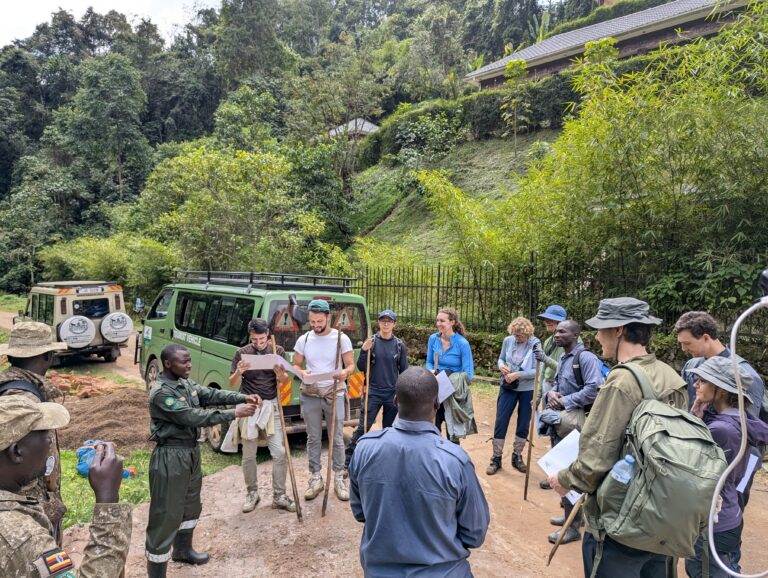
3 Day Uganda Gorilla Trekking Safari
Main Highlights
Batwa Cultural Experience, Forest Walks, Gorilla Trekking, One hour Gorilla Encounter
& More
Common Questions About This Guide
Is Uganda or Rwanda better for gorilla trekking?
Which is cheaper for gorilla trekking, Uganda or Rwanda?
Why is Rwanda gorilla trekking more expensive?
Is Uganda gorilla trekking worth it?
Is Rwanda gorilla trekking worth it?
Which country has more mountain gorillas, Uganda or Rwanda?
Is Bwindi better than Volcanoes National Park?
How much is a Uganda gorilla permit in 2026?
How much is a Rwanda gorilla permit?
Can I do gorilla habituation in Rwanda?
Is gorilla trekking safe in Uganda and Rwanda?
What is the best month for Uganda vs Rwanda gorilla trekking?
Can Kuzora Safari Tours plan both Uganda and Rwanda gorilla trekking?
Related Posts
Continue with articles selected from shared topics, categories, and practical safari planning context.
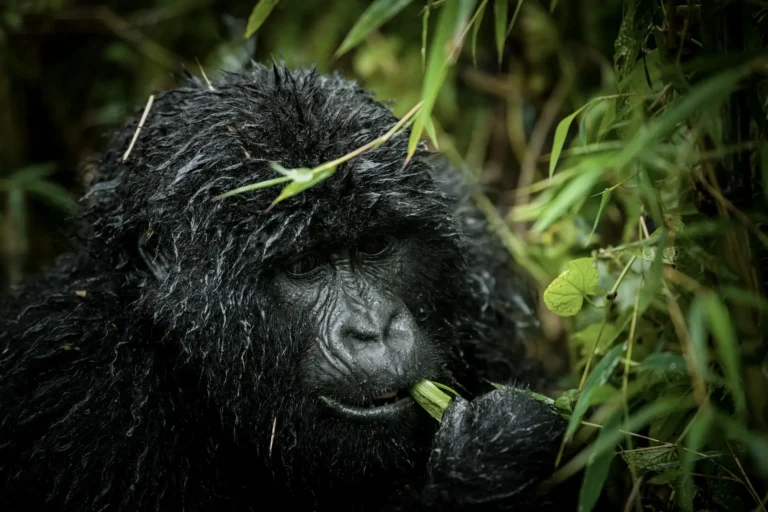
Rwanda Gorilla Permit Cost and Booking Guide
Rwanda Gorilla Permit Cost and Booking Guide A Rwanda gorilla permit is the official ticket that allows you to trek mountain gorillas in Volcanoes…
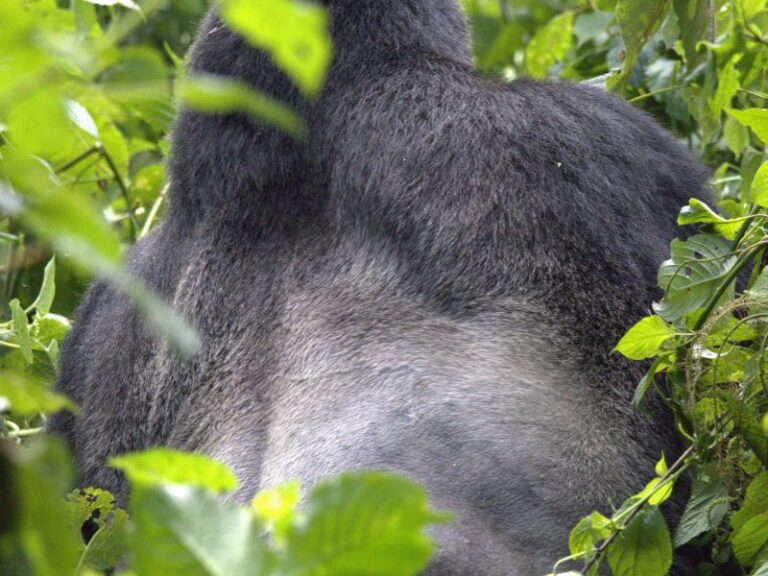
Silverback Gorilla Weight: How Much Does a Gorilla Weigh?
Silverback gorilla weight is usually between 300 and 440 pounds, which is about 136 to 200 kilograms. Some very large males may be heavier,…
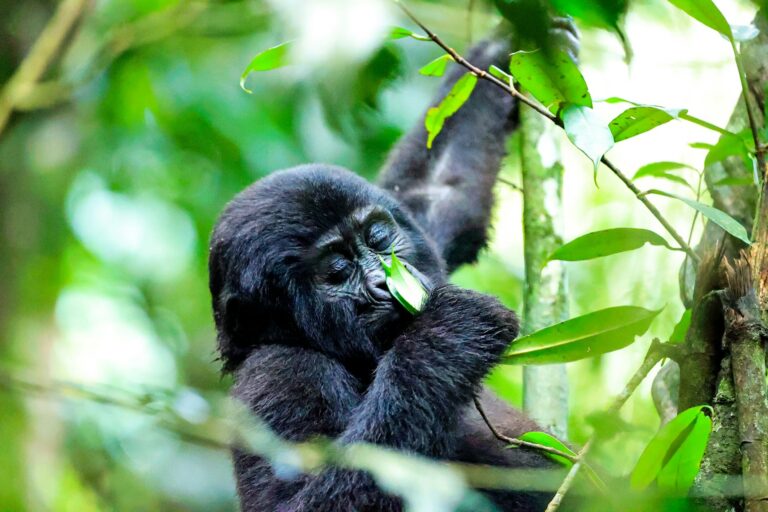
Uganda Gorilla Safari Cost 2026: What You Really Need to Budget
Planning a gorilla safari in Uganda is exciting, but let us be honest: the first serious question most travelers ask is not about the…
Enjoyed this guide?
Tap the heart to show appreciation. The total updates live for this safari guide.
Contents